

Claire Mawisa,
Marco Oriunto,
Nicky Troll and
Jo MunnikBBC Africa Eye, Cape Town & London
 BBC
BBCAlthough psychedelic drugs are illegal in South Africa, many self-appointed healers and shamans based in Cape Town are openly advertising that they incorporate them in their therapies.
Anyone convicted of their commercial use faces a fine, a prison sentence of up to 25 years, or both.
Photographer Stuart Dods is one of those willing to take the treatment from a shaman.
In an elegant wooden cabin nestled in the forest on Cape Town’s outskirts, he is about to undergo his second psychedelic experience to treat a series of mental health issues he has been suffering from. He has tried prescription medication but is convinced psychedelics hold the key to his healing.
“Mum passed away suddenly, so that was a hell of a thing. And then my ex broke off a year after mum died as well. So that’s kind of when the rug got pulled out a little bit,” says the 53-year-old.
At a cost of around $2,000 (£1,500), the psychedelic experience he has chosen involves taking doses of psilocybin (also known as magic mushrooms) and MDMA (also known as the party drug, ecstasy). The organisers say the fee also includes accommodation and a package of support services.
There is a growing body of research and trials into their effectiveness in treating mental health conditions, but there are warnings about their use outside of controlled, clinical settings.

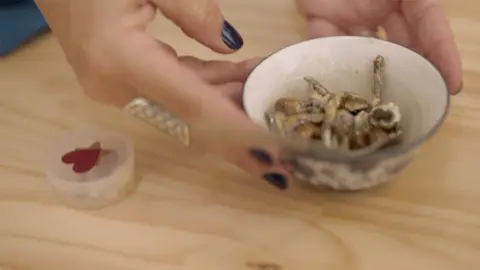
Megan Hardy, who refers to herself as a “medicine woman” and is in charge of the session with Mr Dods, also takes a smaller dose of both drugs ahead of the ritual. She claims it helps her “move into the same frequencies” as the person she is treating.
“The shamanic term is a foot in each world,” she says.
Ms Hardy is aware of the illegality of using these types of drugs, but she claims the use is “righteous civil disobedience”.
When asked what qualified her to determine the correct dose to administer, she said that over the years she had tested the drugs on herself, “learning what works in what situation”.
Greater awareness of mental health issues, coupled with a rise in the clinical trials involving psychedelics, has fuelled public interest in the use of these drugs to treat conditions like depression, anxiety and Post-Traumatic Stress Disorder (PTSD).
One in two people worldwide may develop a mental health disorder in their lifetime, according to studies from Harvard Medical School and the University of Queensland – treating it has become a multi-billion-dollar business.
Before the psychedelic ceremony begins, which Stuart has agreed for the BBC World Service to film, Ms Hardy reassures her client he can stop at any time.
“If any of it feels uncomfortable or it’s a triggering process… communicate that and say: ‘OK, stop.'”
Her colleague, Kate Ferguson, has also micro-dosed on MDMA and magic mushrooms. Neither guide has had formal medical training.
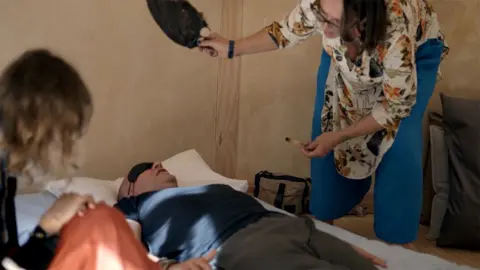
Mr Dods lies down on a thin mattress on the floor of the cabin, covered with a grey duvet. He is wearing an eye mask. As the drugs begin to take effect, he seems to alternate between states of calm and moments of twitching and jerking.
“Let yourself feel it,” whispers Ms Hardy, hugging him.
The two women move around the room, burning herbs and shaking shamanic rattles while singing and chanting in a purification ritual known as “smudging”. Ms Hardy fans Mr Dods’s body using the wing of a bird, in what she says is an attempt at clearing “negative energy”.
She then offers him more MDMA. He has already consented to this before the ritual began but when Ms Hardy asks him whether he needs it, he shrugs and says: “I don’t know.'”
The BBC questions Mr Dods afterwards about how he could consent to taking more drugs when he was already in an altered state.
“There was no coercion. It was more just me figuring out in that space, do I want to take this? I had every opportunity to say: ‘Yay’, ‘nay’, or ‘yeah, I’ll take it,'” he says.
But there are many people in the professional world of psychiatry who point to the dangers of this unregulated industry.
“In order to give consent, you have to be in touch with reality,” said Dr Marcelle Stastny, the convenor of the South African Society of Psychiatrists.
“If a person has already had psilocybin and MDMA, they aren’t in touch with reality. They’re intoxicated, they’re high. And [in] a lot of the trials worldwide, real boundary violations are happening.”
The BBC asked Ms Hardy if being under the effect of the drugs herself while leading the psychedelic experience did not compromise her ability to take care of Mr Dods.
“That’s based on the assumption that a sober state of mind is more desirable,” said the self-styled healer. “We’re working in ways that the Western mind doesn’t understand and can seem scary.”
There is a growing body of research looking into whether psychedelics could be a viable alternative treatment for conditions like depression or anxiety and…

