

Tabby Wilson and Tiffanie TurnbullBBC News, Sydney
 Marianna Massey/Getty Images
Like many Australians, Rach grew up “terrified of the sun” in the country with the highest rates of skin cancer in the world.
Her childhood was characterised by the infamous “no hat, no play” rule that is commonplace in Australian schools, 90s advertisements that warned the sun would give you cancer, and sunscreen tubes that stood guard at every door in her home.
It made the now 34-year-old the kind of person who religiously applies sunscreen multiple times a day and rarely leaves the house without a hat.
So she was shocked when doctors found a skin cancer on her nose during a check last November, something they said was abnormal given her age and ray-dodging regime.
Though technically classified as a “low grade” skin cancer – a basal cell carcinoma – it had to be surgically removed, leaving the Newcastle mum with a scar just below her eye.
“I was just confused, and I was a little bit angry because I was like, ‘Are you kidding me?'” Rach – who asked that her surname not be used – told the BBC. “I thought I’d done all the right stuff and it still happened to me.”
That rage grew when she learned the sunscreen she had been using for years was unreliable and, according to some tests, offered next to no sun protection at all.

 ABC News/Billy Cooper
Independent analysis by a trusted consumer advocacy group has found that several of Australia’s most popular, and expensive, sunscreens are not providing the protection they claim to, kicking off a national scandal.
There has been a massive backlash from customers, a probe launched by the country’s medical watchdog, multiple products pulled from shelves, and questions raised about the regulation of sunscreen around the globe.
“It’s definitely not an issue isolated to Australia,” cosmetic chemist Michelle Wong told the BBC.
The reckoning
Australians have a complicated relationship with the sun: they love it, but they also fear it.
Effective public health messaging – which has drilled “Slip, Slop, Slap” into their heads – competes with a beauty culture which often idolises bronzed skin.
The country has the highest incidence of skin cancers in the world and it is estimated that two out of three Australians will have at least one cut out in their lifetime.
So when Choice Australia released its damning report in June, it immediately made waves. The group had tested 20 sunscreens in an independent accredited Australian lab, finding 16 did not meet the SPF, or skin protection factor, rating listed on the packet.
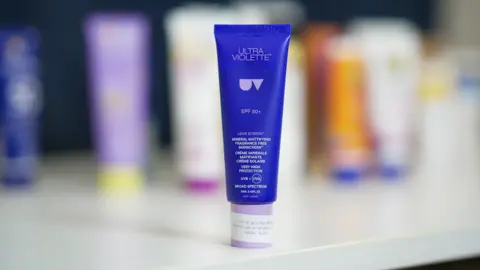
Ultra Violette’s Lean Screen SPF 50+ Mattifying Zinc Skinscreen, a facial product that Rach says she used exclusively, was the “most significant failure” identified. It returned a result of SPF 4, something that shocked Choice so much it commissioned a second test that produced a similar reading.
Other products that did not meet their SPF claims included those from Neutrogena, Banana Boat, Bondi Sands and the Cancer Council – but they all rejected Choice’s findings and said their own independent testing showed their sunscreens worked as advertised.
 Getty Images
The uproar was immediate for the brands named in the report, and also prompted a swift response from the Therapeutic Goods Association (TGA), which said it would investigate the findings and “take regulatory action as required”.
Ultra Violette bit back, saying they were “confident that Lean Screen is safe and effective” and detailing extensive testing of the product – which has been sold in almost 30 countries, including the UK, and retails for upwards of A$50 (£24, $33).
But less than two months later, it announced that Lean Screen would be recalled after it returned inconsistent results across eight different sets of lab testing.
“We are deeply sorry that one of our products has fallen short of the standards we pride ourselves on and that you have come to expect of us,” read a statement published to the brand’s Instagram account.
It added that it has “since ended the relationship with the initial testing lab”.
In the past fortnight, other brands have “paused” the sale of at least four more products, none of which were included in the Choice report.
Rach knows there is no way to prove that there is a link between her diagnosis and the brand of sunscreen she relied on. She says she is not alleging there is such a connection.
But she said Ultra Violette’s response to the scandal was like “a kick in the guts”.
She felt that they took no real accountability for the pitfalls of their product, and was let down by their decision to continue selling it for two months despite doubts over its efficacy.
“I just had like the five stages of grief, you know?” she said. “I was angry, I was upset, I was almost in denial.”
Like…
Loading PerspectiveSplit analysis...

