

Editor, BBC Global Disinformation Unit
BBC Global Disinformation Unit
 BBC
BBCListen to Juliana read this article
Javier Gallardo likes to start his morning watching a classical music programme on television – it is part of his routine, and puts him in the right mood for the day before going to work driving trucks.
But one Monday in June, he turned on the television and, instead of music, the screen was filled with images of a warzone. A news report was playing on a channel he had never heard of.
“What’s happening?” he asked himself. After 20 minutes, he turned it off. “I couldn’t connect with it.”
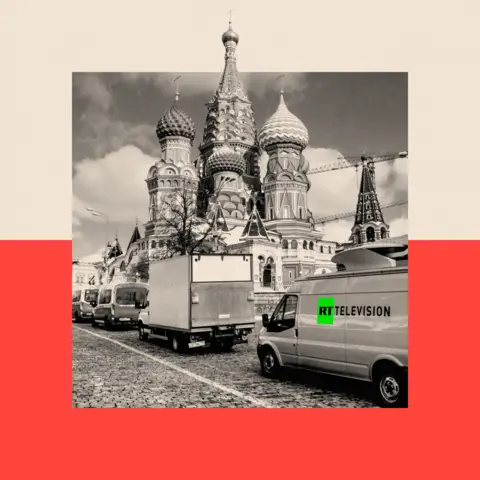
A green logo at the bottom corner of the screen showed the letters: “RT”. Searching online, he found that this was a Russian channel.
Javier lives in Chile. It is alleged that Telecanal, a privately-owned TV channel in the country, has handed over its signal to Russian state-backed news broadcaster RT, formerly Russia Today.

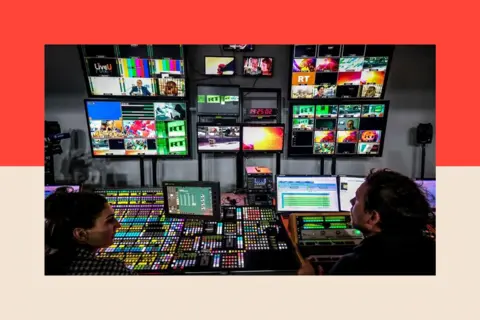 Photo by YURI KADOBNOV/AFP via Getty Images
The country’s broadcasting regulator has opened sanction proceedings against Telecanal for a possible violation of broadcasting law, and is waiting for the channel’s response.
Telecanal did not respond to request for comment.
Viewers, meanwhile, were left confused.
“I got upset,” admits Javier. “They didn’t announce anything beforehand, and I couldn’t understand why.”
Over the last three years, the Russian state-backed news channel RT and news agency and radio Sputnik, have expanded their international presence; between them, they now broadcast across Africa, the Balkans, the Middle East, Southeast Asia and Latin America.
This all coincides with bans in Western countries.
 Kirill KUDRYAVTSEV / AFP
Following Russia’s full-scale invasion of Ukraine in February 2022, sweeping restrictions were imposed to RT’s broadcasting in the US, UK, Canada and across the European Union – as well as by major tech companies – for spreading disinformation about the war.
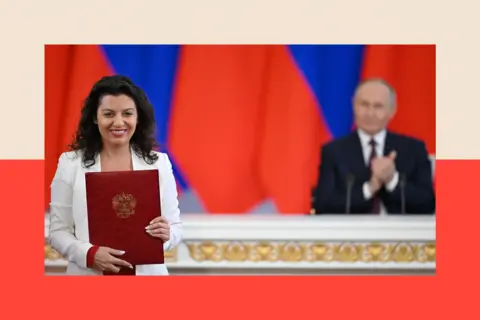
This culminated in 2024, when US authorities sanctioned RT executives – including its editor-in-chief Margarita Simonyan – for alleged attempts to harm “public trust” in the country’s institutions.
It came amid accusations of the Kremlin orchestrating a widespread campaign to interfere in the presidential election. RT denied involvement.
Yet elsewhere, RT’s influence has only expanded.
Since 2023, RT has opened a bureau in Algeria, launched a TV service in Serbian, and started free training programmes aimed at journalists from Africa, Southeast Asia, India, and China.
The broadcaster has also announced it will open an office in India. Sputnik, meanwhile, launched a newsroom in Ethiopia in February.
All of this coincides with an apparent weakening from the Western media in some regions. Thanks to budget cuts and changing foreign policy priorities, certain outlets have downsized and even withdrawn from parts of the world.
Two years ago, the BBC closed its Arabic radio service in favour of its digital-based service – which provides audio, video and text-based news content. It has since launched emergency radio services for Gaza and Sudan. That same year Russia’s Sputnik started a 24-hour service in Lebanon, occupying the airwave vacated by BBC Arabic.
Meanwhile, the US government-funded international broadcasting service Voice of America has cut most of its staff.
“Russia is like water: where there are cracks in the cement, it trickles in,” says Dr Kathryn Stoner, political scientist at Stanford University.
The question that remains, however, is, what is Russia’s endgame? And what does this apparent creeping of media power in those regions mean in an age with a shifting world order?
‘Not all crazy conspiracy theorists’
“[Countries outside the West are] very fertile territory intellectually, culturally, and ideologically [because of their] residual anti-American, anti-Western, and anti-imperial sentiments,” says Stephen Hutchings, a professor of Russian Studies at the University of Manchester.
Russian propaganda, he argues, is also spread smartly: its content is calibrated to cater to specific audiences, even if it means adopting different ideological stances in different regions.
 KIRILL KUDRYAVTSEV/AFP via Getty Images
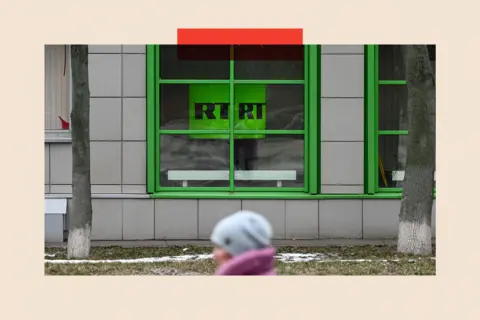
Take the perception of RT. In the West it is often seen as a “Russian state actor and propagator of disinformation,” he says. In other parts of the world, however, it is often regarded as a legitimate broadcaster with its own editorial line.
This makes viewers susceptible to believing it – “not all crazy conspiracy theorists who naively fall for disinformation”.
This is how Dr Rhys Crilley puts it. He is a lecturer in international relations at the University of Glasgow, and believes that RT’s coverage of the world can appeal to broad audiences – “people who are rightly concerned about global injustices, or…


